Ultrasonic Grating Apparatus Manufacturer,Supplier and Exporter in India

Product Code : EL-AP-10749
Quick Answer: The Ultrasonic Grating Apparatus uses a lead zirconate titanate (PZT) transducer in a parallel-sided glass tank, driven by an RF signal in the 8-12 MHz range, to find the speed of sound in liquids.
Last updated: October 2026
Key Features
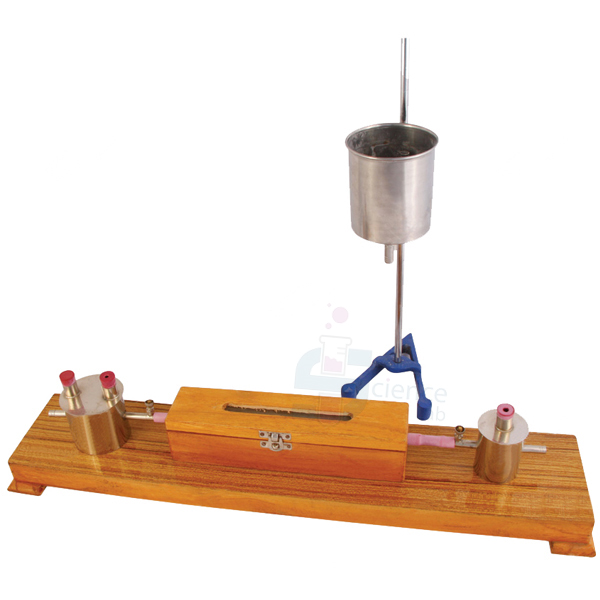
- Parallel-sided glass tank for the liquid sample
- Lead zirconate titanate (PZT) ultrasonic transducer in the tank
- Transducer driven by an RF signal in the 8-12 MHz range
- Standing waves give a periodic change in refractive index along the tank
- Shows how longitudinal sound waves and transverse light waves interact
Technical Specifications
| Specification | Value |
|---|---|
| Weight | 40 lbs |
| Dimensions | 40 × 18 × 8 in |
| Transducer | PZT ultrasonic |
| Drive signal | RF, 8-12 MHz |
| Sample cell | Parallel-sided glass tank |
About This Product
At resonance a standing wave field forms in the liquid, so its refractive index varies periodically along the tank. This shows the interaction of longitudinal sound waves with transverse light waves, and also gives a way to determine the speed of sound in liquids, which is otherwise hard to do in the undergraduate lab. Export orders for the Ultrasonic Grating Apparatus are accepted from Burundi, Honduras, Bulgaria, the Philippines, Eritrea and Togo.
Frequently Asked Questions
What frequency drives the transducer?
The PZT transducer is energised by an RF signal in the 8-12 MHz range.
Related: Advanced Physics, Zeeman Effect Apparatus, Planck Constant Apparatus, Ballistic Galvanometer and Optics.
For a quotation on the Ultrasonic Grating Apparatus, contact Science Lab Export.