Poisson's Ratio of Rubber Apparatus Manufacturer,Supplier and Exporter in India
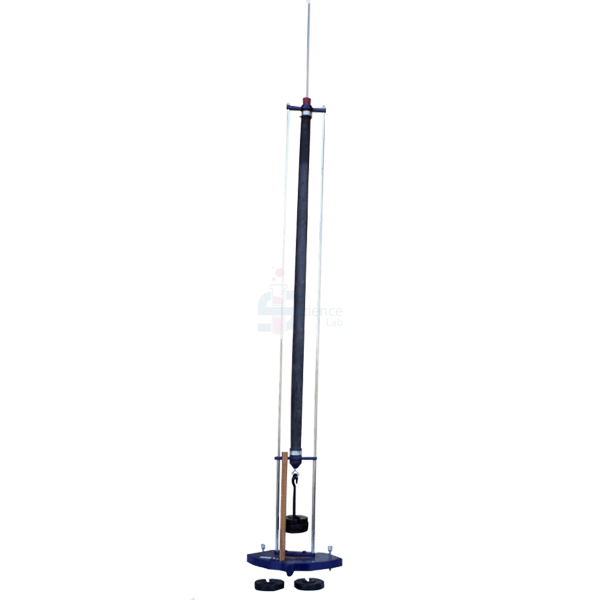
Product Code : EL-AP-11111
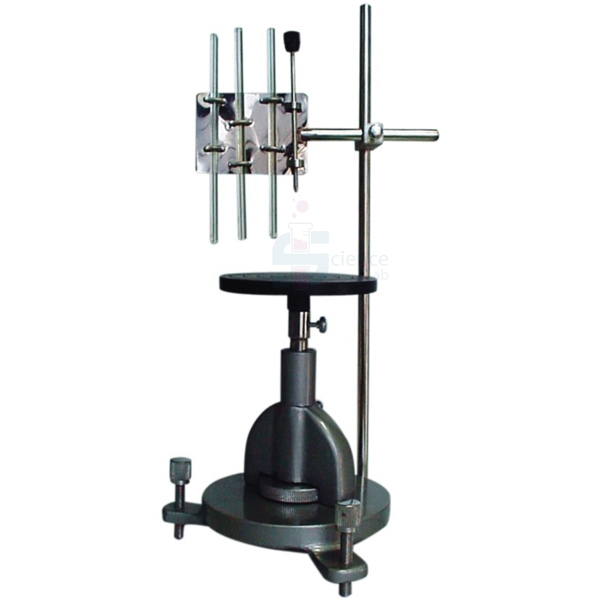
The Poisson’s Ratio of Rubber Apparatus is a specialized
instructional assembly used to determine the ratio of lateral strain to
longitudinal strain in elastomers. Designed for University physics laboratories
and advanced TVET engineering modules, it facilitates the empirical
verification of elastic constants. The system meets ISO manufacturing standards
and is engineered for high-repetition undergraduate laboratory environments.
Technical Specifications
|
Tender Specification |
OEM Technical Detail |
|
Primary Specimen Material |
Industrial-grade vulcanized rubber tubing (Cycle-type) |
|
Specimen Length |
Approximately 1000 mm (1 Meter) |
|
Support Structure |
High-mass, kiln-dried cast iron stand with anti-vibration
base |
|
Measurement Interface |
Integrated precision pointer for longitudinal displacement
tracking |
|
Material Grade |
Grade-A Cast Iron; High-tensile Elastomer |
Key Pedagogical Outcomes
- One-Meter
Homogeneous Rubber Tube: Provides a sufficient gauge length to
generate measurable deformation under low-load conditions, allowing
students to calculate Poisson’s Ratio (\sigma) with high statistical
confidence.
- High-Mass
Cast Iron Base: Ensures axial stability and minimizes structural
damping, supporting Bloom’s Taxonomy levels of "Analyze" and
"Evaluate" during the study of non-Hookean materials.
- Calibrated
Longitudinal Pointer: Facilitates the precise tracking of tube
extension (\Delta L) against volumetric changes, supporting the Applied
Mechanics Module 201 curriculum.
International Logistics & Compliance
Science Lab Export implements rigorous protocols for
international procurement cycles. Equipment is secured in export-grade
seaworthy crating to prevent structural degradation during transit.
Comprehensive documentation is provided with every shipment, including the Manufacturer’s
Authorization Form (MAF), IQ/OQ/PQ Certification, and technical manuals in
English. The apparatus features a tropicalized design, with
chemical-resistant coatings tested for operational stability in environments
reaching 45°C and 90% relative humidity.